
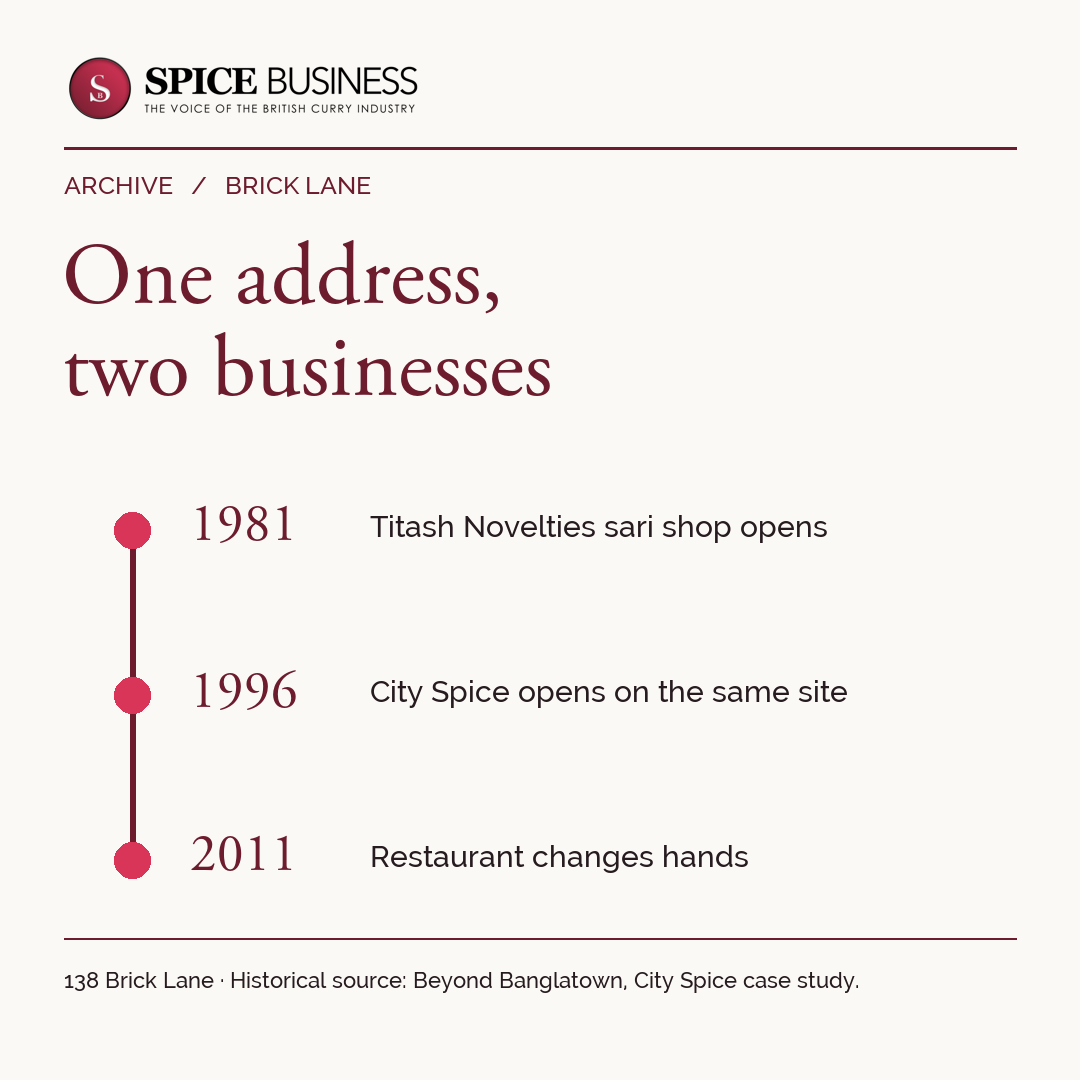
At 138 Brick Lane, a restaurant opening in 1996 marked the end of another business serving the neighbourhood. Titash Novelties had opened there as a sari shop in 1981. When shoppers increasingly travelled to Green Street in Newham, the business lost sales. City Spice opened in its place. The sequence is recorded in the Beyond Banglatown research project’s case study of the premises. Beyond Banglatown, City Spice
The founder had come from Sylhet and had once intended to become a barrister. The shop and the restaurant were successive answers to a commercial question that will sound familiar to a high-street operator today: who still has a reason to travel here? The premises stayed put while part of the customer base moved its spending elsewhere.
There was another change of ownership in 2011. The researchers describe an incoming operator with experience running a takeaway and a convenience store. Alongside the case study are photographs of the building in 2019 and of the restaurant during the 1999 Bangladeshi Festival. These are glimpses of a particular business at particular times. They give the street a more specific history than an undated picture of a crowded dining room.
## The two maps of a high street
For an owner considering a new neighbourhood, draw one map of nearby competitors and another of the journeys customers already make. The first shows where a similar menu is sold. The second may explain why a family passes half a dozen closer doors for a celebration, or why a weekday takeaway trade disappears when a workplace moves.
Those journeys can change within a single tenancy. Local enquiries, a sample of attended bookings and conversations with diners can reveal whether the next source of trade is a nearby household, a visiting group or somebody already loyal to a different branch. The historical record at No. 138 gives an unusually clear starting point for asking the question. It leaves today’s operator the work of finding the local answer.